How to Make a Poo!
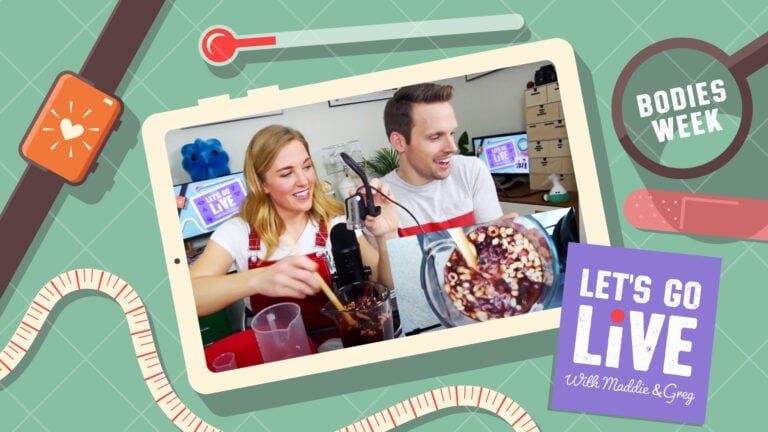
This activity is taken from “Let’s Go Live with Maddie & Greg”, a live family science show on YouTube!
“We love this activity because it is messy, funny, and REALLY interesting. Everybody loves to talk about poo!”

Materials you could use
Stale Food - we went for crackers, bread & cereal but use can use anything you like, although we suggest using stale food that would otherwise be destined for the bin/composter)
Cup of liquid - we liked coffee for the colour but water or squash would also work Label this one “drink”
Mixing Bowls
Potato Masher - or anything with good mashability
3 Cups / Small Bottles of liquid - these are to represent the juices in your body. You could use water or squash and label them ‘Saliva', ‘Gastric Juices’ and ‘Digestive Juices’
Pair Of Tights
2 Ziplock Bags - important that they don't leak… you don't want to get ‘poo’ everywhere
Tea Towel
Scissors
Protective gloves - these are optional as nothing you’re using is dangerous, we just used them to keep our hands clean for the rest of our show. You could use latex gloves or washing up gloves if you like
Safety first!
Although this activity is looking at digestion and should be carried out with food that’s safe to eat, you may wish to remind children not to eat the “food” you are using. (We can’t imagine it would be very tasty!)
Stage 1: Chew and Swallow

1. Pop your gloves on. Put your stale food in the mixing bowl and start breaking it into chunks using the potato masher. Then add liquid and keep mashing.
The mixing bowl represents your mouth. You’re recreating the first stage of digestion where your teeth bite and tear up your food. That uses your incisors - your front teeth that are great for cutting. Adding the liquid is like taking a drink.

2. Now add the liquid from the ‘Saliva’ cup/bottle

3. Keep using that potato masher, ‘chewing’ your food until it is in small enough pieces and wet enough to be ‘swallowed’.
This chewing uses your molars - the large, flat teeth at the back of your mouth that are used to grind your food. Next it’s time to swallow your food.
Stage 2: Food moves to the stomach (the messy bit!)

1. Get a ziplock bag (the stomach), and carefully pour in the mashed up mixture. You may need your hands to help with this part!
When the food is swallowed it goes down the oesophagus and into your stomach. The muscular walls of the oesophagus move in waves to push the food down the tube to your stomach.

2. Add more water (gastric juices). Gastric juices are acids so be careful with these! We’ll tell you more about them in the next step. Zip or seal the ‘stomach’ up (you don’t want any partly 'digested' food to leak out!) and begin to squeeze the contents with your hand. Take your time squeezing and mushing as the 'chyme' stays in the stomach for a while.
How does it feel? Your hands are now acting like the stomach which churns the chewed food up into a thick liquid called chyme. The gastric juices you squeezed in contain substances called enzymes that help to break down the food particles and make it all mushy. In the stomach, the mushy, partly digested food is called ‘chyme’.

3. Placing a bowl underneath, pour the contents of the stomach into one leg of the tights (small intestine), secured at one end with a knot. This can be messy. We found the best method was to pull the tight over the bag, tip the bag up and let the contents of the stomach drop into the small intestines. Keep the tights inside the bowl as many of the juices will start to run out here.
Next, the chyme moves to the small intestine. The small intestine is around 7 meters long and is the longest part of the digestive system. The chyme will spend several hours in the small intestine where this happens.
Stage 3: Inside the small intestines

1. Squeeze some more water (digestive juices) into the opening of the tights. It may seem totally disgusting, but stick with us! Remember, it is just old food stuff.
The small intestine has two large glands attached, called the liver and the pancreas. They send digestive juices to the small intestine to help break your food down further. The juices you are squeezing in help the food become even more watery and break down most of the remains into simple chemicals.

2. Lift the tights above the bowl and squeeze gently.
You will notice some of the liquids or juices are beginning to run out of the walls of the small intestine. These juices carry chemicals that enter the bloodstream. The blood carries the chemicals to the body’s cells. The body then uses those chemicals as fuel for energy and growth. There will be some undigested food leftover. What are we going to do with it?
Stage 4: Inside the large intestines

1. Squeeze out any leftover juices into the bowl, then cut off the excess tight material (you may need an adult to do this part for you) and place the mixture onto a folded tea towel. Roll the tea towel around the mixture and gently squeeze.
The leftover, undigested food then travels into the large intestine. The large intestine is much shorter and wider than the small intestine. The waste material slowly moves through large intestine and it will stay there for between 10 and 20 hours. The large intestine absorbs as much of the rest of the liquid as possible and you’re left with the parts that can’t be digested.

2. Now for our career highlight! Place the drier mixture into a second zip lock bag which represents the rectum.
Cut a small hole in the corner and SQUEEZE! Congratulations - you have made your very own poo!
You might want an audience for a live reaction and some great ‘eeww’ sound effects - we got some great comments in our live chat thread!
When the large intestine has soaked up the water, salts, and nutrients, it will push the now semi-solid food waste into the lower colon and eventually the rectum. The rectum is a bit like a storage area for poo and is the last stop in the digestive system. When you go to the toilet, a ring of muscle called the anus squeezes and relaxes to allow the poo out!

Our favourite fact
A grown up’s small intestine is about 7 metres long - which is the same as measuring Greg from head to toe 4 times!
Downloads
Suitable For
Curriculum Areas
Curriculum Objectives
Year 4: Pupils should be taught to describe the simple functions of the basic parts of the digestive system in humans
Year 6: Pupils should build on their learning from years 3 and 4 about the main body parts and internal organs (skeletal, muscular and digestive system) to explore and answer questions that help them to understand how the circulatory system enables the body to function. (non statutory guidance)
Key Stage 3 Biology: Pupils should be taught about the tissues and organs of the human digestive system, including adaptations to function and how the digestive system digests food (enzymes simply as biological catalysts)
Downloads


Want to support Let's Go Live?
Say thanks with a one-off Ko-fi donation

Or support us monthly on Patreon